

Let’s be honest: most SEO for construction companies is sold as “more traffic”, but traffic doesn’t pour concrete or sign contracts. What you actually want is a steady stream of the right people asking you to bid on the right projects. If your website gets visits but your phone stays quiet, or the only enquiries you get are tiny jobs and tyre-kickers, this article is for you. We’ll walk through why that happens, what good construction company SEO really looks like, and how to turn the people who find you on Google into bid requests you’d actually want to win.
The Real Problem Isn’t Traffic. It’s Bids.
Here’s a conversation we have with contractors all the time.
“We’ve done SEO. We rank for a few things. But we’re still getting most of our work from referrals.”
When we dig in, the story is almost always the same. The website ranks for broad terms like “construction company” or for the company’s own name. It has one services page that lists everything from kitchen remodels to steel buildings. The project gallery is a wall of photos with no context. And the only way to get in touch is a generic contact form that asks for a name, an email and “message”.
None of that is terrible on its own. But together it means Google doesn’t know which projects you’re best at, and the people who do land on your site don’t have enough reasons to pick up the phone. SEO for construction companies only pays off when ranking and converting work together. So let’s look at both, starting with the person on the other side of the search.
What Your Next Client Does Before They Call You
Construction is a considered purchase. Nobody hires a contractor for a $90,000 addition or a commercial fit-out after one quick search. Whether it’s a homeowner, a property manager or a developer, they usually go through something like this:
- They search for the project, not the trade. “Home addition contractor in Sacramento”, “commercial tenant improvement contractor”, “design build firm near me”.
- They shortlist three to five companies from Google Maps, the organic results and maybe a referral or two.
- They check your work. Do you have projects like theirs? In their area? At their budget level?
- They look for proof you’re safe to hire: license, insurance, bonding, reviews, how long you’ve been around.
- They decide how easy you are to deal with. Is it clear what happens after they get in touch? Will someone actually call back?
Every one of those steps is a chance to win or lose the job before you even know it existed. Good construction company SEO gets you onto the shortlist in step two. Your website has to win steps three, four and five.
Why SEO Beats Waiting for the Next Referral
Referrals are wonderful. They’re warm, they trust you and they close fast. The problem is you can’t control when they arrive. One quiet quarter and your schedule has gaps you didn’t plan for.
Bid boards and lead marketplaces fill some of those gaps, but you’re usually competing with a crowd on price, and the lead is often sold to several contractors at once. Paid ads work too, but the moment you stop paying, the enquiries stop.
SEO for construction companies is different. When your pages rank for the projects you want, you’re in front of people who are actively planning that work, in your area, and they come to you directly. There’s no per-lead fee and no bidding war to get noticed. It takes longer to build, but once it’s working, construction company SEO keeps bringing in enquiries month after month, which is exactly what you need to plan crews and cash flow with confidence.
The best approach for most contractors is a mix: referrals for warm work, ads for quick wins, and construction SEO as the steady engine underneath it all.
Where SEO for Construction Companies Usually Leaks Leads
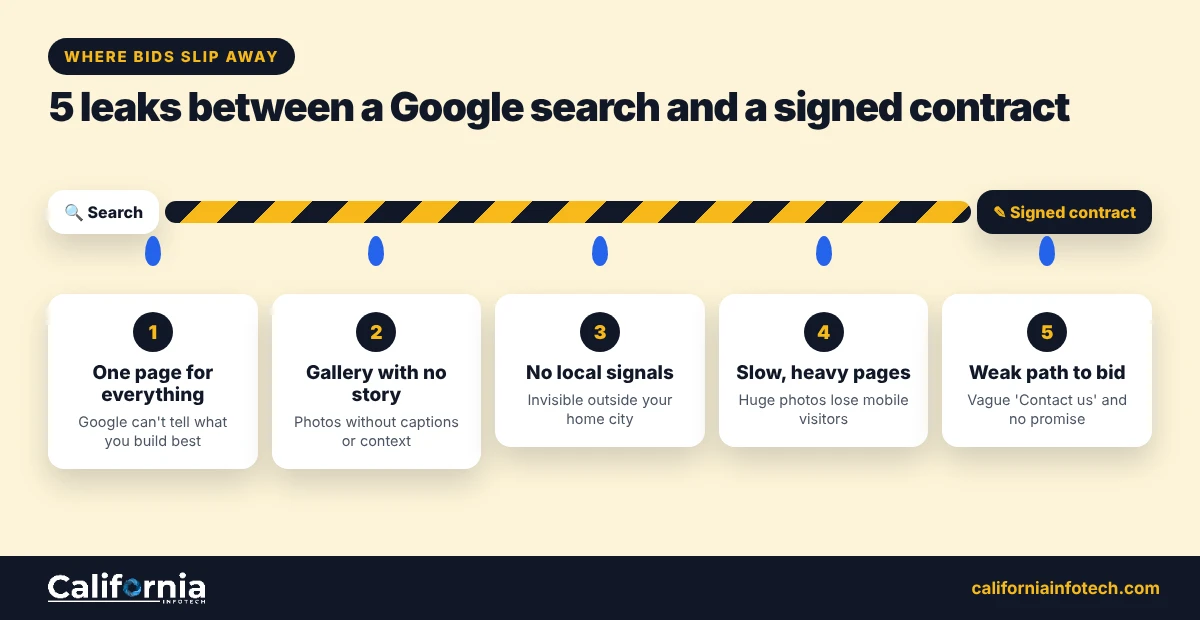
Think of your website as a pipeline from search to signed contract. When we audit construction company SEO, these are the five leaks we see most often.
Leak 1: One Page Trying to Rank for Everything
A single “Services” page can’t rank for “commercial build-outs”, “custom home builder” and “concrete foundation contractor” at the same time. Google needs a clear page for each type of project you want more of. It’s the most common gap we see in SEO for construction companies.
Leak 2: A Project Gallery With No Story
Photos are great, but a gallery with no captions tells Google nothing and tells the visitor very little. Projects are your best sales tool and one of your best SEO assets, if you treat each one as its own page.
Leak 3: No Local Signals
If you work across several cities or counties but your site only mentions your head office, you’ll struggle to show up anywhere else, and your construction SEO will stall. Google’s local results are driven by relevance, distance and prominence, which you can read about in Google’s guide to local ranking.
Leak 4: Slow Pages Full of Huge Photos
Construction sites are image-heavy, which is fine, until a 12MB hero photo makes the page crawl on a phone at a job site. Slow pages lose visitors and rankings.
Leak 5: A Weak Path to “Request a Bid”
This is the big one. Visitors who are ready to talk need an obvious next step, a short form that asks the right questions and a promise about what happens next. We cover more of these problems in our article on the biggest SEO mistakes construction companies make.
What Construction Company SEO Looks Like When It Actually Works
Now the good part. Here’s what we put in place when construction company SEO is built to win projects, not just rankings.
Pages That Match the Projects You Want
Start with your most profitable work. If you want more commercial tenant improvements, design-build projects and home additions, each gets a dedicated page. That page explains what you do, who it’s for, typical timelines, the process from first call to handover, and real examples. It should read like a conversation with your best estimator, not a brochure.
Ask yourself one question for every service page: if a developer read only this page, would they know whether we’re a good fit for their project? If the answer is no, the page needs work.
Project Pages That Sell for You
Turn your best jobs into short case studies. Each project page should cover:
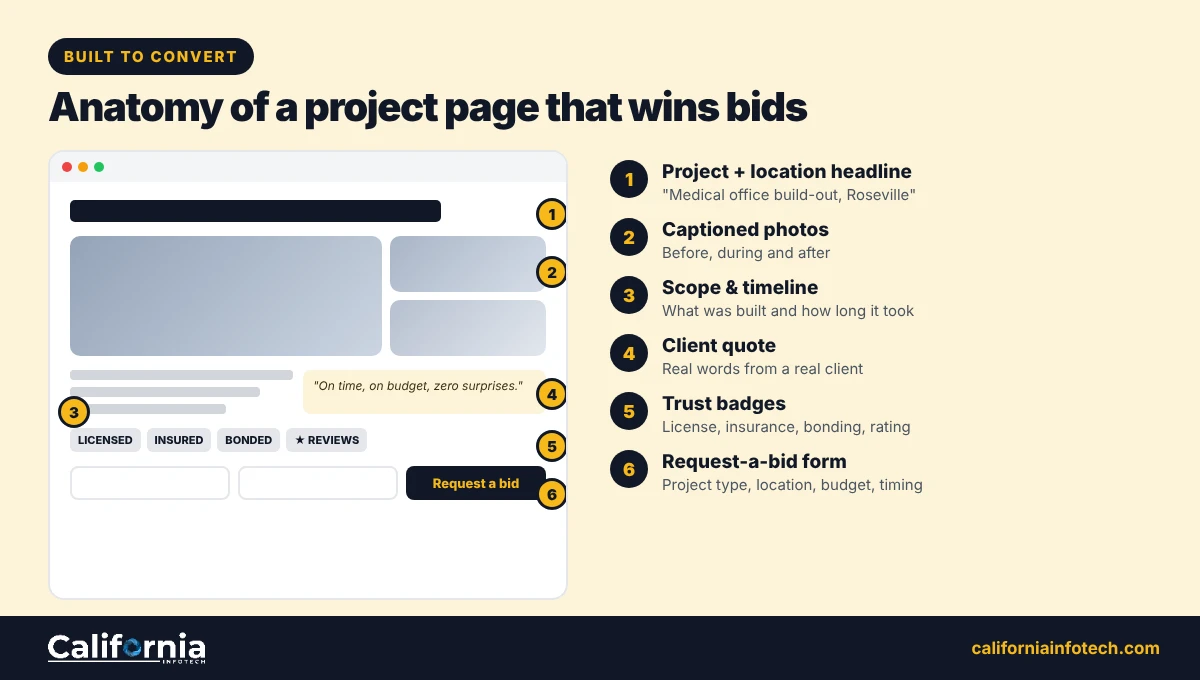
- The project type and location, written naturally (“a 4,000 sq ft medical office build-out in Roseville”)
- The client’s challenge and what made the job tricky
- Scope, timeline and how you kept it on track
- Before, during and after photos, each with a short, descriptive caption
- A quote from the client, if they’re happy to give one
- A link to the related service page and a clear call to action
These pages rank for long, specific searches that bring serious buyers, and they give visitors the proof they’re looking for in step three. In construction company SEO, they’re often the pages that convert best.
A Google Business Profile That Looks Busy
In construction SEO, your profile is often the first thing people see. Pick accurate categories, list every service, add your service area and upload real project photos every month. Post updates when you finish a job. And ask every happy client for a review, because reviews help both your rankings and your close rate. Our Google Business Profile optimization checklist walks through every setting.
Service-Area Pages With Real Local Detail
If you build across a region, create a page for each important city or county. Not a copy-and-paste page with the city name swapped, but a genuinely useful one: projects you’ve completed there, local permit notes, the types of buildings common in the area and who to contact. Thin location pages can hurt you. Helpful ones are one of the strongest tools in construction SEO.
Authority From the Industry and the Community
Links and mentions from trusted, relevant sites tell Google you’re a real, established business. In SEO for construction companies, the best sources are usually trade associations, suppliers and manufacturers you work with, architects and engineers you partner with, local chambers of commerce, community sponsorships and local news coverage of your projects.
A Fast, Mobile-Friendly Site
Compress images, use modern formats and keep pages lean. Your site should load quickly on a phone, because that’s how many property managers and homeowners will first see it.
Want to know which of these leaks is costing you projects? We’ll review your website, Google Business Profile and local rankings, and show you exactly where bid requests are slipping away.
Turn Visitors Into Bid Requests
Ranking gets you seen. Converting gets you paid. These are the changes that make SEO for construction companies pay off, the ones that usually make the biggest difference to how many visitors become real enquiries.
Replace “Contact Us” With “Request a Bid”
“Contact us” is vague. “Request a bid”, “Get a project estimate” or “Book a site visit” tells people exactly what happens next. Put that button in your header, at the end of every service and project page, and on mobile where a thumb can reach it.
Ask Smarter Questions in Your Form
A good bid request form is short but useful. Ask for project type, location, approximate budget range, ideal start date and the best way to reach them. You’ll filter out poor-fit leads and walk into the first call already knowing what matters.
Make a Promise About Response Time
“We’ll call you within one business day” is a small line that does a lot of work. Then keep the promise. Fast follow-up wins more construction jobs than almost anything else.
Put Trust Right Next to the Button
License number, insurance and bonding, years in business, star rating and a short client quote should sit right beside your call to action. People hesitate at the moment of contact. Give them a reason to keep going.
Show the Process
Many clients worry about the unknown: what happens after the first call, how pricing works, how long until work starts. A simple four-step “how we work” section removes that worry and makes reaching out feel low-risk.
Residential vs Commercial: Two Different Buyers
If you do both, your website needs to speak to both. The table below shows how their priorities differ.
| Residential clients | Commercial clients | |
|---|---|---|
| Who’s searching | Homeowners, often a couple deciding together | Property managers, developers, business owners, architects |
| Typical searches | home addition contractor, custom home builder, kitchen remodel contractor | commercial general contractor, tenant improvement contractor, design build firm |
| What builds trust | Reviews, photos, clear process, financing options | Project portfolio, safety record, bonding, schedule and budget control |
| Best call to action | Book a free consultation or site visit | Request a bid or capabilities statement |
| Sales cycle | Weeks to a few months | Months, often with formal bidding |
If most of your residential work is new homes, our home builder SEO services go deeper on that audience. If it’s renovations and additions, see our home remodeling SEO page.
How Long Before SEO Brings Real Projects?
We’ll give you the honest answer: it depends, but construction company SEO progress usually comes in stages.
- First 1–2 months: fixes to your Google Business Profile, site speed, tracking and your most important service pages. Map visibility often starts to move here.
- Months 3–6: new project and service-area pages start ranking for more specific searches, and bid requests begin to pick up.
- Months 6–12: authority builds, rankings broaden and SEO becomes a dependable source of qualified projects alongside referrals.
Because construction sales cycles are long, judge results on bid requests and won contracts over time, not just this month’s rankings. Track where every enquiry came from, how many turned into bids and how many bids you won. That’s the scorecard that matters.
A Quick Self-Check: Is Your Website Costing You Projects?
Use this quick construction company SEO self-check and answer honestly. Every “no” is an opportunity.
- Does each type of project you want more of have its own page?
- Do your best projects have their own case study pages with captions and context?
- Do you show up in Google Maps in the cities where you want work, not just near your office?
- Is your Google Business Profile updated with new photos and reviews every month?
- Does every page have a clear “Request a bid” or “Book a consultation” button?
- Does your form ask about project type, location, budget and timing?
- Are your license, insurance and reviews visible next to your calls to action?
- Does your site load quickly on a phone?
- Do you know how many bid requests came from Google last month?
If you answered “no” to three or more, you’re very likely leaving good projects on the table. The good news is that these are all fixable, and most of them don’t require a new website.
Should You Do It Yourself or Bring In Help?
Plenty of contractors handle the basics themselves, like updating the Google Business Profile, asking for reviews and adding project photos. That’s a great start and we’d encourage it.
Where most teams get stuck is consistency. Writing detailed project and service pages, fixing technical issues, earning links and tracking results takes steady effort every month, and it’s always the first thing to slip when you’re busy on site. That’s usually when it makes sense to bring in a partner who does construction company SEO every day.
If you do, ask a few direct questions. Have they worked with contractors before? How will they measure bid requests, not just rankings? Who owns the website and data? What exactly do you get each month? A good partner will have clear, specific answers.
How We Help Construction Companies Win More Bids
At California Infotech, our approach to SEO for construction companies starts with the projects you want more of and works backwards. We build focused service and project pages, strengthen your Google Business Profile and reviews, create genuinely useful service-area pages, earn industry and local links, and set up tracking so you can see exactly how many bid requests come from search. You keep full ownership of your website and accounts.
You can see the full scope on our construction SEO services page or compare plans on our SEO packages page. Or, if you’d rather just talk it through, tell us a little about your business below and we’ll come back to you with honest, practical next steps.
Frequently Asked Questions
What is SEO for construction companies?
It’s the work of improving your website and Google Business Profile so your construction company shows up when potential clients search for the projects you do, in the areas you serve, and then turning those visitors into bid requests.
How is construction company SEO different from regular SEO?
Construction projects are high-value, local and slow to decide. That means more focus on project pages, service-area relevance, trust signals like licensing and bonding, and tracking bid requests and won contracts rather than just traffic.
How long does construction SEO take to work?
Most contractors see early movement in Google Maps within one to two months and a noticeable increase in qualified enquiries over three to six months, with steady growth after that.
Do I need a new website for SEO?
Usually not. Most construction websites can be improved with better service pages, project case studies, faster loading and clearer calls to action. A rebuild only makes sense if the site is very outdated or hard to edit.
How much does SEO for construction companies cost?
It depends on how many services and locations you want to target and how competitive your market is. Compare what’s included each month, such as pages, content, links and reporting, rather than price alone.
Keep reading
More guides for home service businesses, plus services that can help.
Related articles
Services that can help
Want more calls from Google?